2026-11-05 ·
Hail Damage on the Front Range: When to Repair vs Replace Your Roof
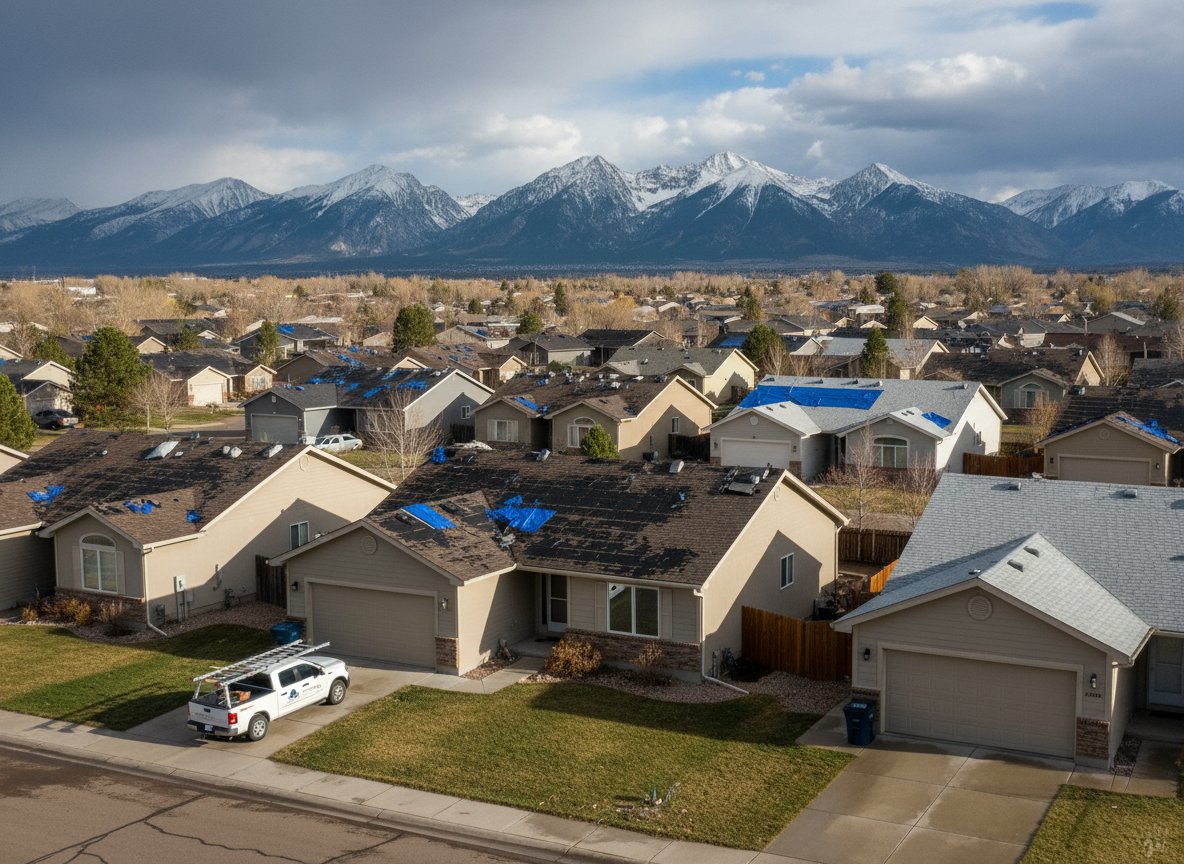
In Evans and across Weld County, roofs with scattered hail dents and less than 20% granule loss can usually be repaired, while widespread cracking, active leaks, or missing shingles over 30% of the surface call for replacement. This threshold holds for the asphalt-shingled homes common near Evans City Park and the Weld County Fairgrounds, where semi-arid continental climate brings hard spring hail followed by intense sun that accelerates granule loss.
Spotting Hail Damage Specific to Evans Homes
Hail in Weld County often arrives with winds that drive pellets under shingle edges on north-facing slopes common in LaSalle neighborhoods. Walk the roof after a storm and look for crushed granules collecting in gutters, bruised felt showing through, or soft spots near the ridge. Homes built in the 1980s and 1990s around Evans Town Center frequently show damage concentrated along the lower third of the roof because older underlayment has already dried out from decades of UV exposure. Check twice in the same week because small cracks can open further once daytime highs return to the 80s. Document every mark with photos that include the date and a tape measure for later insurance review.
Repair Limits on Front Range Roofs
Repairs work best when damage stays isolated to one or two slopes and the remaining shingles still seal properly. A roofer can replace individual damaged shingles and seal exposed nails without disturbing the rest of the system, provided the underlayment remains intact. In Greeley and Evans, this approach often succeeds on roofs less than 12 years old that have not yet reached the typical 15- to 20-year lifespan for standard three-tab shingles. Once leaks appear in more than two locations or granule loss reaches the point where the mat is visible across multiple courses, patching no longer restores full weather protection. Storm damage roof repair addresses these targeted fixes while the rest of the roof still has service life left.
When Replacement Makes Sense in Weld County
Replacement becomes the practical choice when hail has compromised the entire roof plane or when the existing shingles are already near the end of their expected life. In Evans, many homes near the fairgrounds sit on lots with full southern exposure, so hail plus constant sun shortens shingle life to roughly 12-15 years. If a storm leaves soft spots along multiple valleys or lifts shingles along the eaves, new material prevents repeated leaks during the next monsoon season. Full replacement also allows underlayment upgrades that handle the freeze-thaw cycles common in northern Colorado. Roof replacement restores a uniform surface that matches the wind and hail ratings needed for this county. Readers comparing material options can review metal vs asphalt shingles for Colorado homes to see how each performs after repeated hail events.
Local Weather Patterns That Change the Decision
Weld County's semi-arid continental climate delivers hail in May and June, then weeks of 90-degree days that bake exposed felt. This cycle makes even small granule loss progress faster than in wetter climates. Homes in LaSalle often sit on open ground with little tree cover, so every storm strikes the full roof surface. When deciding between repair and replacement, factor in the age of the roof relative to the last major hail event in the area. A 10-year-old roof that took moderate damage may reach replacement age before the next cycle, making a full job the lower long-term cost. Checking neighboring roofs in Greeley gives a quick read on how local conditions are aging similar installations.